
The Anatomy of a Dopamine Loop: Why You Can't Stop Swiping
You pick up your phone to check an urgent email, see a notification badge, tap into Instagram or YouTube, and before you realize what has happened, 45 minutes have vanished.
This is not an accident or a character flaw. It is the predictable outcome of an engineered behavioral loop. Modern short-form video platforms exploit the mesolimbic dopamine pathway (specifically the ventral tegmental area and nucleus accumbens):
- Anticipation Over Consumption: Dopamine is not a pleasure molecule; it is a molecule of motivation and pursuit. The surge occurs not when you watch a good video, but in the microsecond before you swipe, wondering what comes next.
- Intermittent Novelty: If every video was amazing, your brain would reach sensory saturation. If every video was boring, you would put the phone down. By mixing dull, mediocre, and shocking clips at random intervals, recommendation engines create a slot-machine dynamic that keeps your thumb flicking indefinitely.
| Digital Approach | Dopamine Impact | Cognitive State | Sustainable Outcome |
|---|---|---|---|
| Infinite Short-Form Feeds | Spikes and crashes from variable ratio novelty | Fragmented attention, chronic cognitive fatigue | Restless boredom and shortened focus span |
| Total App Deletion | Sudden deprivation causing withdrawal cravings | Isolation from friends, work chats, and tutorials | Rebound bingeing within 48 to 72 hours |
| Selective Interception (ScrollDetox) | Stable dopamine baseline without artificial spikes | Deep executive focus; messaging preserved | Sustainable 2+ hours daily attention restored |
What Clinical Research Reveals About Attention & Working Memory
Over the past several years, behavioral researchers and clinical neurobiologists have documented the physiological toll of continuous short-form video consumption:
- Dopamine Baseline Downregulation: As explained in clinical addiction research at Stanford University School of Medicine (Dr. Anna Lembke), the brain continuously maintains neurobiological homeostasis. When bombarded by relentless spikes of artificial stimulation, the brain compensates by decreasing dopamine receptor availability. This leads to a persistent "dopamine deficit state", making normal, slow-paced activities (reading a textbook, writing code, having a conversation) feel painfully tedious.
- Working Memory Depletion: Peer-reviewed studies indexed in the National Institutes of Health (PubMed) show that evaluating dozens of disparate video stimuli in a 15-minute window strains working memory capacity. Each video requires decoding new faces, emotional tones, audio tracks, and jokes, leaving the prefrontal cortex depleted of cognitive bandwidth.
- Circadian Disruption & Melatonin Suppression: Research published by Harvard Medical School highlights that late-night screen exposure disrupts circadian rhythms. High-contrast, dynamic video motion in dark environments delays melatonin release by up to 90 minutes, impairing deep restorative REM sleep.
The Willpower Paradox: Why Mental Effort Alone Fails
Willpower is governed by your prefrontal cortex, the same brain region responsible for decision-making, emotional regulation, and impulse control.
Throughout a typical workday, your executive energy steadily declines. By evening, relying on willpower to resist algorithms calibrated by thousands of machine-learning models is an unfair fight. When you feel tired, your basal ganglia takes over, defaulting to automated muscle memory.
To protect your attention, you cannot rely on willpower. You must install environmental and software friction that blocks the automatic gesture before the habit loop starts.
The 4-Step Neuro-Reset Protocol
You do not need to delete your accounts or buy an expensive distraction-free phone. You can rewire your baseline attention by applying four structured boundaries:
1. Disarm the Infinite Swipe Feed
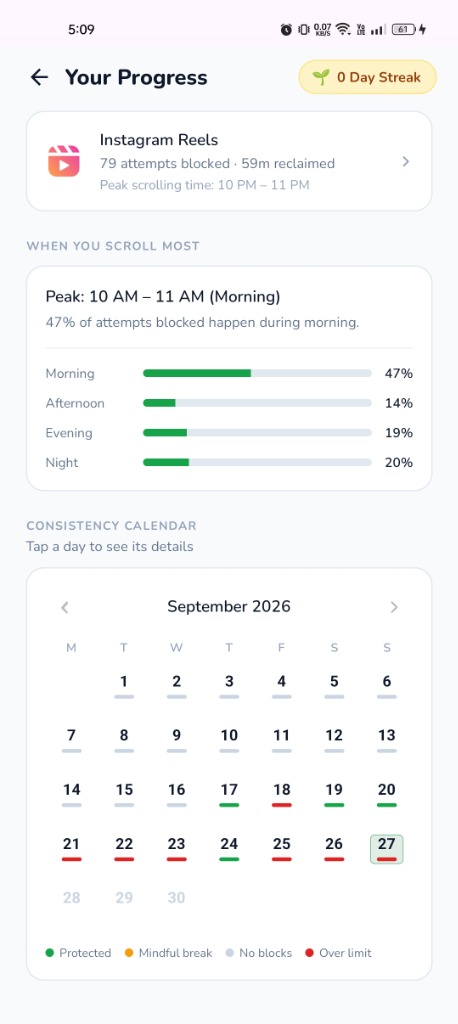
Keep what serves you, eliminate what drains you. Use Instagram for DMs and creator posts; use YouTube for tutorials, lectures, and music. But cut off the vertical short-form autoplay engine. ScrollDetox achieves this by monitoring only the fullscreen Reels and Shorts players on Android and triggering an instant exit when they appear.
2. Reintroduce Natural Stopping Cues
Traditional media had natural stopping points: books had chapters, magazines had back covers, television broadcasts had credits. Infinite feeds deliberately eliminate stopping cues. If you want to watch a video, choose long-form content with a visible timestamp so your brain consciously registers the duration.
3. Enforce 1-Pass Boundaries on Shared Links
When friends send a funny clip, rigid blockers force you to choose between being antisocial or unlocking the app entirely. With ScrollDetox's 1-Pass Mode, you watch the intended video, but the second your thumb swipes down into algorithmic recommendations, the app automatically exits back to your chat.
4. Schedule Nightly Grayscale
Set your Android phone to Bedtime Mode at 10:00 PM to turn the display monochrome. Color is the primary sensory trigger for digital novelty; removing it drastically lowers the dopamine reward value of visual feeds, allowing your nervous system to wind down naturally for sleep.